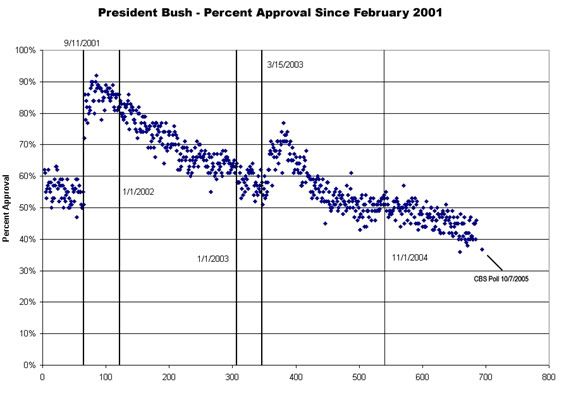
This year the Governator has requested a special election in California in order to bolster his sagging poll numbers. It seems pretty strange that he would put his efforts behind four propositions that he deems important to his cause. The next regular election in California would be the spring primaries and it is doubtful that any of Arnold’s initiatives would make any difference for California in those five months. However, it is more likely that if Arnold gets his way on any of these issues it could actually make him relevant to California again.
There are actually eight propositions on the California ballot this time around. Three of the propositions are aimed at giving the Governator more power. The fourth one, proposed by Arnold, changes the rules on redistricting. There are two proposals having to do with prescription drugs. There is one on the notification of parents when a teenager wants to get an abortion. And, the final one has to do with the regulation of electrical power.
Before I get into the details of any of these propositions I thought that I would just write about the idea of initiatives. What are they good for? And, what is the down side to the initiative process?
The original use of the initiative process was based on the idea that the state politicians were being influenced by the Railroads back in the late 1800s. The Railroads had a lot of money and they donated generously to all of the politicians. Therefore, in order to be elected the Railroads needed to like a politician. And, in order to be re-elected a politician needed to vote in favor of the Railroads.
When the Railroads interest was no longer California’s interest there wasn’t much that could be done to strike down these laws until an active group of Californians were able to circumvent the politicians and pass some Railroad regulations in order to protect California. If anyone wants the details of the history of the California Initiative Process check out
this link.
The question that we should be asking ourselves at this point in our history is the initiative process good for California? The reason we need to ask this question is because of the complicated structure of laws. When politicians create and pass laws they do it because it is their occupation. They have the responsibility to understand the current state of the laws in California and they have the responsibility to understand the effect of each new law that is passed. The politicians generally have teams of lawyers, interns and experts with the mission to understand each proposed law and the implications of its passage. The people of each district give this responsibility to their representatives and the people have the responsibility to make sure their representatives uphold this responsibility. This means that each voter clearly has a responsibility to make sure that his or her representatives are acting in good faith.
Most people do not put enough effort into this process. Instead they rely on advertisements at election time to tell them who they should vote for. Unscrupulous politicians are generally less than forthcoming with telling the public about what they have done or plan to do. Unscrupulous politicians also tell us lies and deceptions about their opponents. Only voters who spend the time and effort to read between the lines and look at voting records are truly informed enough to make clear decisions. But in a free country many people vote without educating themselves. The information is out there, but it is hard to find. So, unscrupulous politicians are elected year after year. The system is imperfect, but we try to get it right with every election.
So, if voters have such a hard time selecting representatives each election, why should voters be any better at passing laws?
As an example of passing a law through the initiative process we could look at Proposition 13. This famous taxpayer initiative was an effort to control property taxes. It is about 25 years since the initiative passed and we are dealing with the repercussions of this today. In the 1960s California had one of the finest education system in the country. This had a lot to do with the rapid rise in real-estate prices. Before prop. 13 taxes would increase as the value of your house increased. Therefore when there was a housing boom as there usually is in California prices rose and the taxes of everyone’s house rose and money continued to flow into government coffers. Most of this surplus was used to improve education throughout California building new schools and improving the schools that existed. The top-notch University of California and the California State University systems were built and there wasn’t any tuition for California residents.
There was a problem for people who were trying to live on a fixed income. These people may have paid off theirs houses and then retired. They had budgeted money for everything they needed and when taxes were collected every year this expense continued to increase at a rate much higher than their income.
Politicians didn’t want to upset the balance and they refused to reduce the property taxes. If things are running smoothly, why should they put their foot down. Well, the Howard Jarvis Taxpayers Association created a proposition to fix the solution. And, it was passed overwhelmingly by voters.
This was both good and bad for Californians. The result was a fairer property tax scheme based on the purchase price of your home and not it’s current value. Therefore, people who have lived in a house for 30 years pay a much lower rate than the people next-door that just moved in. The other result is that there is much less money for education. Every school system in the state is slowly deteriorating. California is slowly sinking to the bottom in test scores and performance on College Entrance Exams.
People argue that you don’t need money to make a school system work. But, there is certainly a correlation between money spent, cost of living, and results in public education over the last 50 years. If teachers are well paid in your state, then people are willing to become teachers because the profession is respected enough for the teachers to be compensated.
So, back in 1978 when prop 13 was passed, did people really want to pull the rug out from education? Did people think about this and know what prop 13 would do? Of course not, people wanted to fix the property tax problem. Was there a debate about different ways to fix the property tax problem? Was prop 13 the best way to fix the problem? No and no, prop 13 could have been done in a better way if the California legislature had the guts to take on the problem. So, Californians were left with a quick fix to a difficult problem that the politicians didn’t want to touch.
With this in mind, I think that Californians should think about the use of the initiative process in the future. It is great for making quick fixes, but it shouldn’t be considered to proper solution for most cases. After all, should the legislature be doing their jobs?
PS Don’t forget that today is the last day to register to vote in the Special Election.
politics,
California Special Election,
California Propositions